
Why in news?
The Sea of Japan has drawn attention in recent months due to regional geopolitical tensions and disputes over its naming, as well as extreme weather events that brought heavy snowfall to Japan’s western coast. Understanding this semi‑enclosed sea’s geography and oceanography helps explain its strategic and ecological significance.
Background
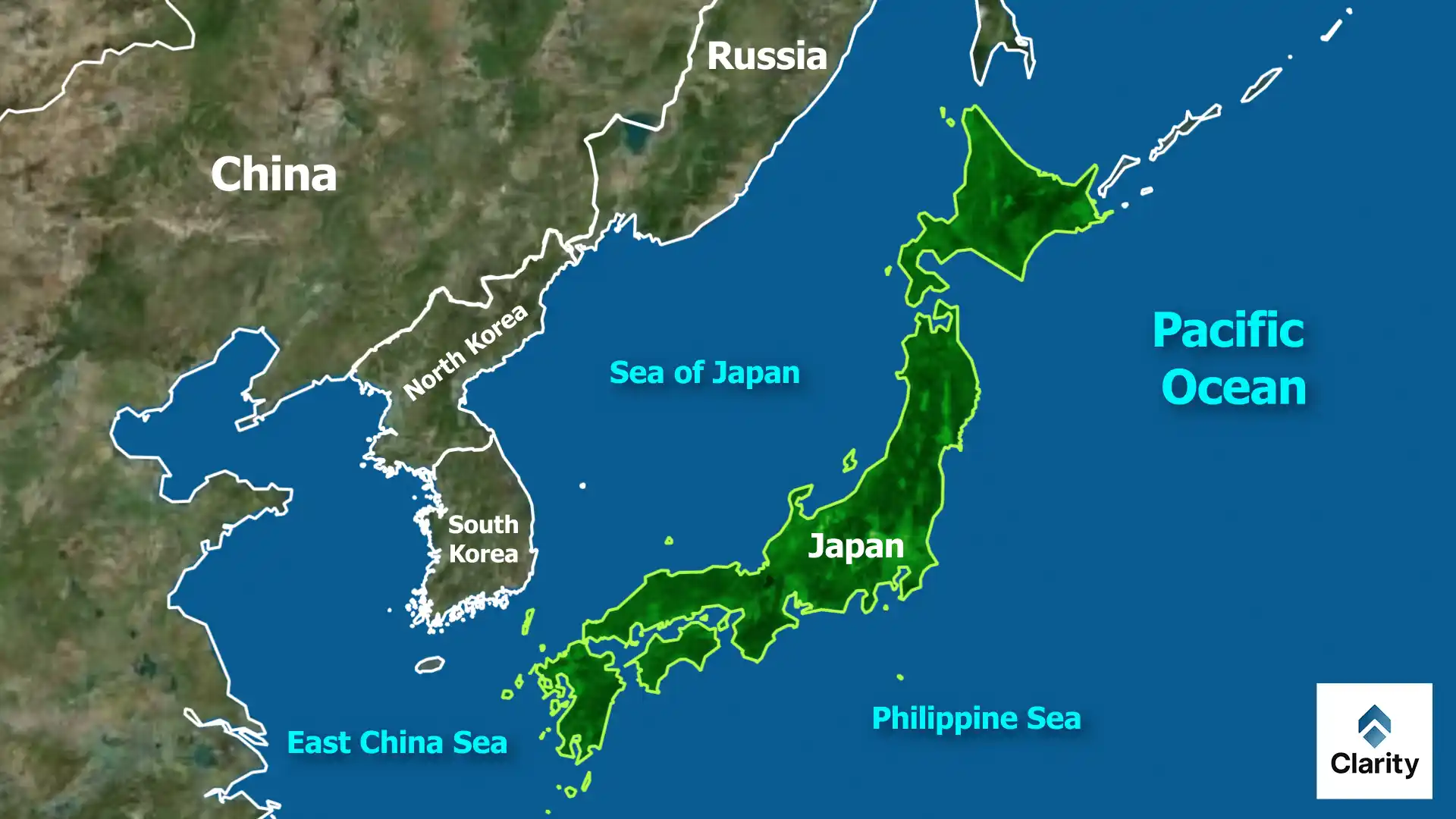
The Sea of Japan (called the East Sea in Korea) lies between the Japanese archipelago and the Korean Peninsula and Russian Far East. It is connected to neighbouring seas through five narrow straits: the Strait of Tartary to the north, La Pérouse (Soya) Strait between Sakhalin and Hokkaidō, Tsugaru Strait between Honshū and Hokkaidō, Kanmon Straits between Honshū and Kyūshū, and the Korea Strait to the south. These shallow passages restrict water exchange, making the sea relatively isolated.
The sea covers roughly 1 million km² with an average depth of about 1 750 m and a maximum depth of over 4 500 m. Three deep basins—the Japan, Yamato and Tsushima basins—are separated by undersea ridges. Continental shelves are broad along Japan’s eastern margin but narrow on the Korean side. The semi‑enclosed nature creates unique circulation patterns.
Oceanography and climate
- Monsoonal influence: In winter, cold north‑west monsoon winds blow across Siberia and pick up moisture over the sea, leading to heavy snowfall on the Japanese side. In summer, warm, humid air flows from the south, producing a humid rainy season.
- Warm and cold currents: The Tsushima and East Korea Warm Currents flow into the sea from the south, while the Liman Cold Current brings chilly water from the north. These currents form a counter‑clockwise gyre, driving nutrient‑rich upwelling and supporting abundant fisheries.
- Seasonal ice: In the northern reaches near Russia, the sea surface freezes for several months each winter. Floating ice influences shipping and marine life.
Economic and geopolitical significance
- Fisheries: The Sea of Japan is renowned for sardines, mackerel, crab and squid. Fisheries support coastal communities in Japan, Korea and Russia, but overfishing and climate change threaten these resources.
- Shipping lanes: The sea forms a vital maritime highway linking the Sea of Okhotsk and the East China Sea. Major ports such as Vladivostok, Busan and Niigata rely on its shipping routes.
- Naming dispute: South Korea advocates the name “East Sea,” while Japan uses “Sea of Japan.” International hydrographic organisations have yet to settle the matter, and both names are used in different contexts.
The Sea of Japan illustrates how geography shapes climate, livelihoods and geopolitics. Managing its fisheries sustainably and navigating naming sensitivities require cooperation among neighbouring nations.
Sources : TH