
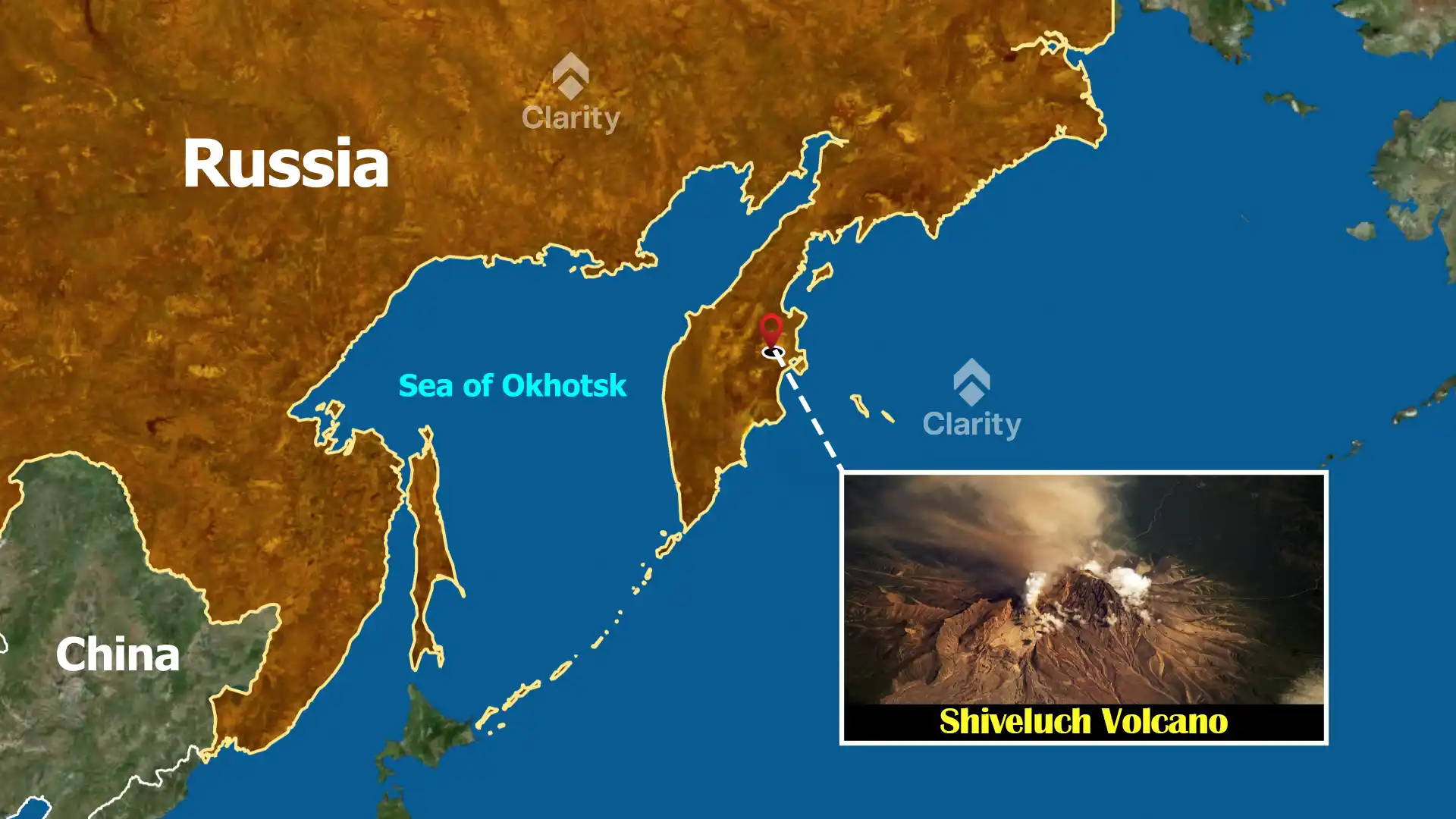
Why in news?
Russia’s Shiveluch (Sheveluch) volcano on the Kamchatka Peninsula erupted explosively in late January 2026, sending ash plumes high into the atmosphere. Air‑traffic alerts were briefly raised to red as ash clouds drifted hundreds of kilometres, although the event had limited humanitarian impact.
Background
Shiveluch is one of the largest and most active stratovolcanoes on the Kamchatka Peninsula in Russia’s Far East. Its summit reaches 3,283 metres. Key points:
- Structure: The volcano consists of an older edifice (Old Shiveluch) and a younger dome complex (Young Shiveluch) within a broad caldera. It is built of alternating layers of lava, ash and debris, and hosts growing lava domes prone to collapse.
- Eruptive history: Shiveluch has produced at least 60 large eruptions during the Holocene epoch. Major historical eruptions occurred in 1854 and 1964. Dome collapses often trigger pyroclastic flows and debris avalanches.
- Recent activity: According to the Kamchatkan Volcanic Eruption Response Team, during 22–28 January 2026 explosive activity at the “300 years of RAS” dome produced ash plumes rising 4–10 km into the air. An explosion on 23 January generated plumes that reached 10 km and drifted 50 km northeast. The aviation colour code was briefly raised to red. Ash clouds continued to drift hundreds of kilometres, and further plumes were observed on 26–28 January. Despite significant ash fall near the volcano, few people were affected due to the remote location.
- Geological setting: The volcano lies within the volcanic arc of the Kuril–Kamchatka subduction zone, where the Pacific plate descends beneath the Eurasian plate. Frequent seismic and volcanic activity characterises this region.
MSN