
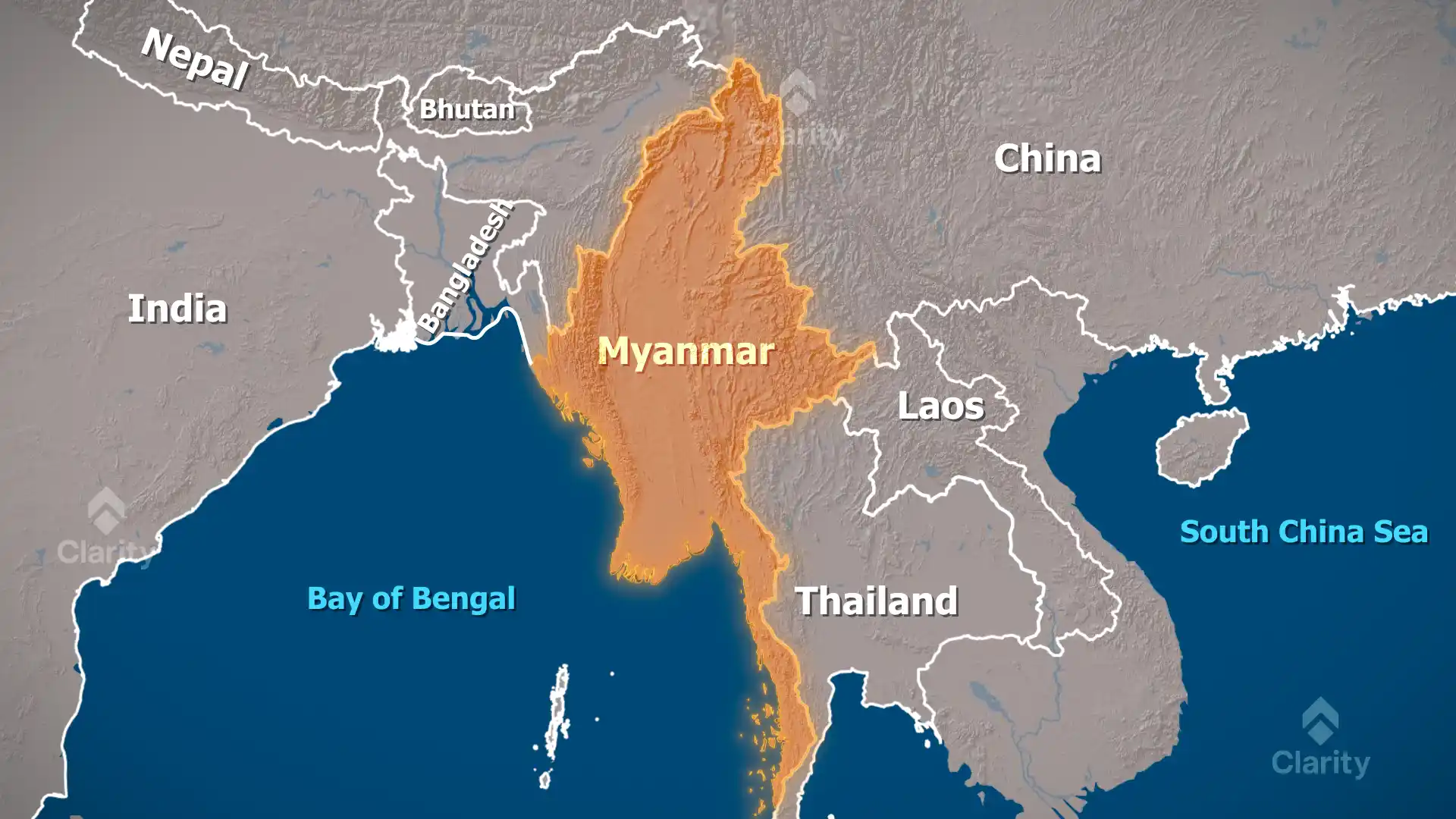
Why in news?
Myanmar has drawn international attention after its military‑backed Union Solidarity and Development Party (USDP) claimed a large share of seats in the country’s 2025–26 general election. The vote, held under military rule and boycotted by many opposition parties, has heightened concerns about democracy in the country and spurred interest in its geography and resources.
Background
Located in Southeast Asia, Myanmar (also known as Burma) lies at the crossroads between South and East Asia. It is bordered by India and Bangladesh to the west, China to the north and east, Laos and Thailand to the east and southeast, and the Bay of Bengal and Andaman Sea to the south. The capital is Naypyidaw, while Yangon remains its largest city and commercial hub.
Geographical features
- Diverse landscapes: The country ranges from the snow‑clad Hkakabo Razi in the northern Himalayas (Myanmar’s highest peak at 5,881 m) to the Ayeyarwady (Irrawaddy) River delta in the south. Mountain chains such as the Rakhine Yoma, Bago Yoma and Shan Hills run north‑to‑south, separating fertile river valleys.
- Major rivers: The Irrawaddy River is Myanmar’s lifeline, flowing north‑to‑south for about 2,170 km and supporting agriculture and transport. Other important rivers include the Chindwin (a major tributary of the Irrawaddy), the Salween (Thanlwin), and the Sittoung.
- Tropical monsoon climate: Myanmar experiences a hot and wet monsoon season (May–October), a cool dry season (November–February) and a short hot season (March–April). Rainfall is heavy along the coastal regions and much lower in the central dry zone.
- Natural resources: The country is rich in petroleum, natural gas, timber, tin, tungsten, and gems such as jade and rubies, although mismanagement and conflict have hindered equitable development.
Political context
The 2025–26 general election was conducted under a military‑drafted constitution. Reuters reported that the USDP secured a majority of seats, while voter turnout was around 55 percent. Key opposition groups boycotted the polls in protest of the 2021 coup. Critics argue that the military’s continued grip on power and civil conflict call into question the legitimacy of the vote. International bodies, including ASEAN members, have expressed concern about the lack of inclusivity and transparency.
Significance
- Strategic location: Myanmar’s position between India, China and Southeast Asia gives it geopolitical importance for trade routes, energy pipelines and security.
- Biodiversity and culture: The country hosts diverse ethnic groups and ecosystems, from tropical rainforests to alpine meadows, making it both culturally rich and ecologically important.
- Challenges: Ongoing conflict, political instability and humanitarian crises continue to affect the country’s development and relations with neighbours.
Source: TH