
Why in news?
Mexico’s Senate recently approved significant tariff increases—up to 50 percent—on imports of automobiles, textiles and other goods from countries without free‑trade agreements, including India, China and several other Asian nations. The move aims to protect domestic industries and raise revenue ahead of upcoming trade negotiations.
Background
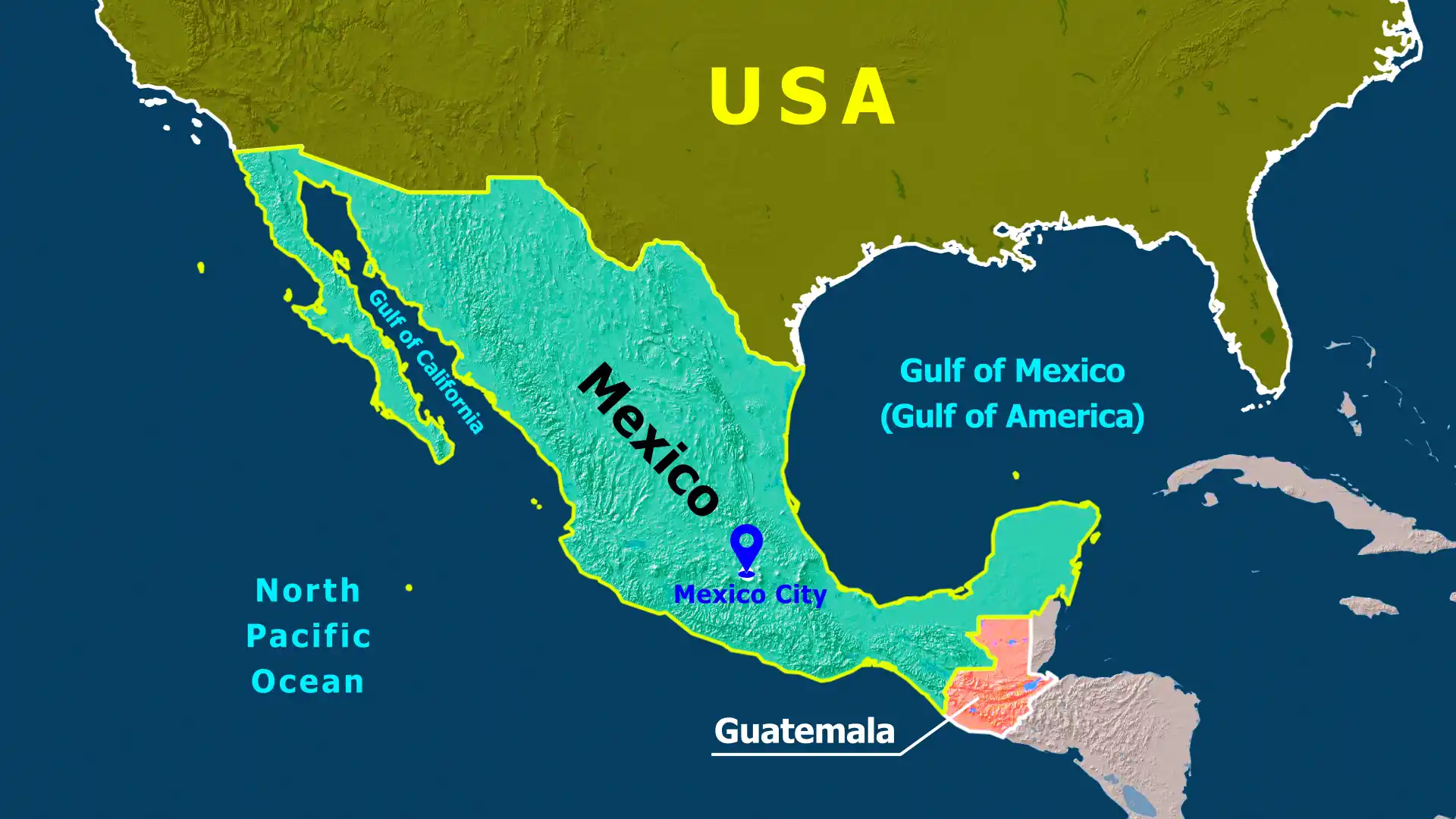
Mexico is a large country situated in the southern part of North America. It shares long land borders with the United States to the north and with Belize and Guatemala to the south. To the east, Mexico is bounded by the Gulf of Mexico and Caribbean Sea, while the Pacific Ocean lies to the south and west. The country lies within the seismically active Pacific “Ring of Fire” and features diverse landscapes ranging from deserts and volcanoes to tropical forests.
Geographic highlights
- Peninsulas: Mexico comprises two major peninsulas—the Baja California Peninsula in the northwest and the Yucatán Peninsula in the southeast.
- Mountain ranges: The Sierra Madre Occidental and Sierra Madre Oriental run roughly parallel along the western and eastern coasts, respectively. These ranges give rise to high plateaux where most major cities are located.
- Rivers and lakes: Important rivers include the Rio Grande (known as the Río Bravo del Norte in Mexico), which forms part of the border with the United States, and the Colorado River. Lake Chapala is the country’s largest freshwater lake.
- Natural resources: Mexico is endowed with petroleum, silver, copper, gold, lead, zinc and natural gas, making mining and energy significant sectors of its economy.
- Capital city: Mexico City, located on a high plateau in the Valley of Mexico, is the political and cultural heart of the nation.
Recent tariff decision
Mexico’s Senate voted in December 2025 to impose duties of up to 50 percent on imported goods from countries that do not have trade agreements with Mexico. Products such as cars, auto parts, textiles, clothing, plastics and steel will face new tariffs when entering Mexico in 2026. Supporters argue that the measures will protect Mexican jobs and industries, while critics worry about higher consumer prices and potential trade disputes. Observers note that the decision may also be intended to appease the United States ahead of the USMCA trade agreement review.
Conclusion
Mexico’s geographical diversity and abundant natural resources have long shaped its economy and culture. The latest tariff increases reflect domestic economic priorities as well as complex trade relations with global partners. Understanding Mexico’s geography helps contextualise its economic and political decisions.
Source: TH