
Why in news?
India has submitted a nomination dossier to UNESCO requesting that Meghalaya’s living root bridges be inscribed on the World Heritage list for the 2026‑27 cycle. The dossier, prepared by the Government of Meghalaya and the Indian National Commission for Cooperation with UNESCO, underscores the unique cultural and ecological value of these bridges.
Background
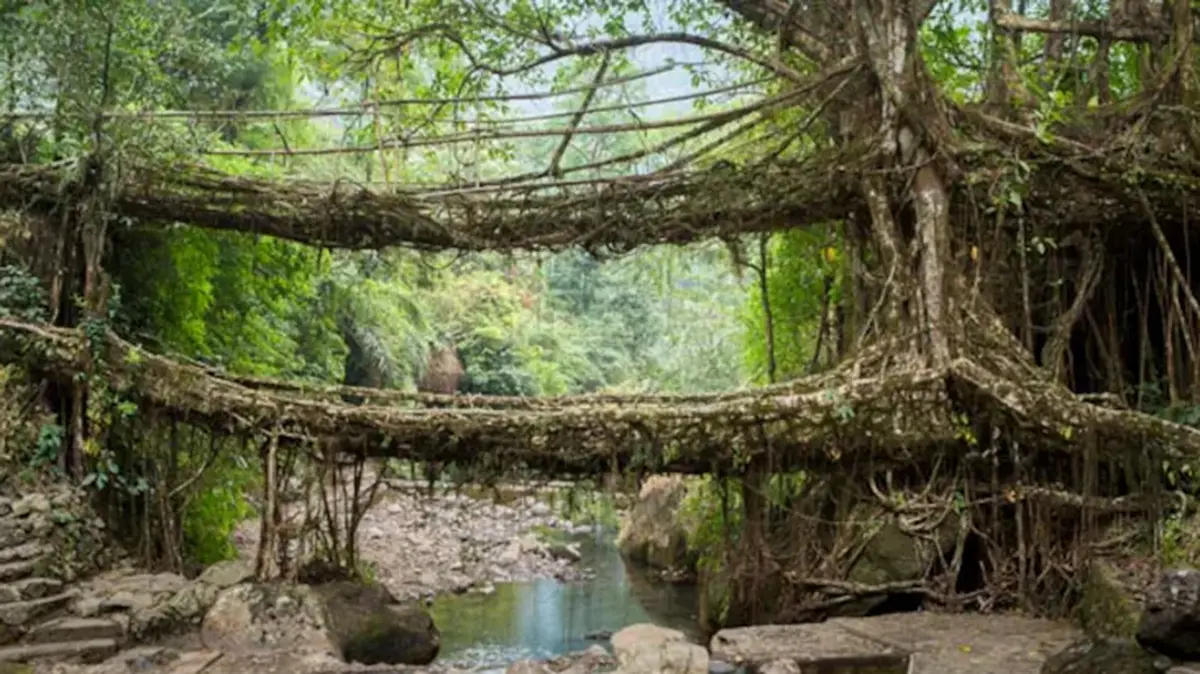
Living root bridges, known locally as jingkieng jri in Khasi and lyu chrai in Jaintia, are handmade bridges formed by training the aerial roots of the rubber fig tree (Ficus elastica). Indigenous communities in Meghalaya’s Khasi and Jaintia hills have perfected this technique over centuries to cross turbulent streams during monsoons. Because the bridges grow stronger over time, they exemplify a harmonious relationship between people and nature.
How these bridges are made
- Root guidance: Villagers divert young aerial roots across a river using bamboo or areca‑nut trunks as scaffolding. As the roots grow, they wrap around the framework and anchor into the soil on the opposite bank.
- Years of growth: It can take 10–15 years for a bridge to become sturdy enough for daily use. Once mature, a living root bridge can span 15–65 metres and support dozens of people at a time.
- Maintenance: Residents continuously guide new roots over the bridge and prune away excess growth. The structure thickens over generations and can last for centuries.
- Environmental benefits: Unlike steel or concrete bridges, living root bridges filter water, bind soil and provide habitat for birds and insects. They also reduce the need for felling trees and importing construction materials.
Significance of the UNESCO nomination
The nomination recognises that living root bridges are not just functional structures but living heritage that reflects indigenous knowledge systems. Inscription on the World Heritage list would raise awareness, attract responsible tourism and provide resources for conservation. It would also honour the custodians—mainly women and elders—who maintain these bridges.
Source: NOA