
Why in news?
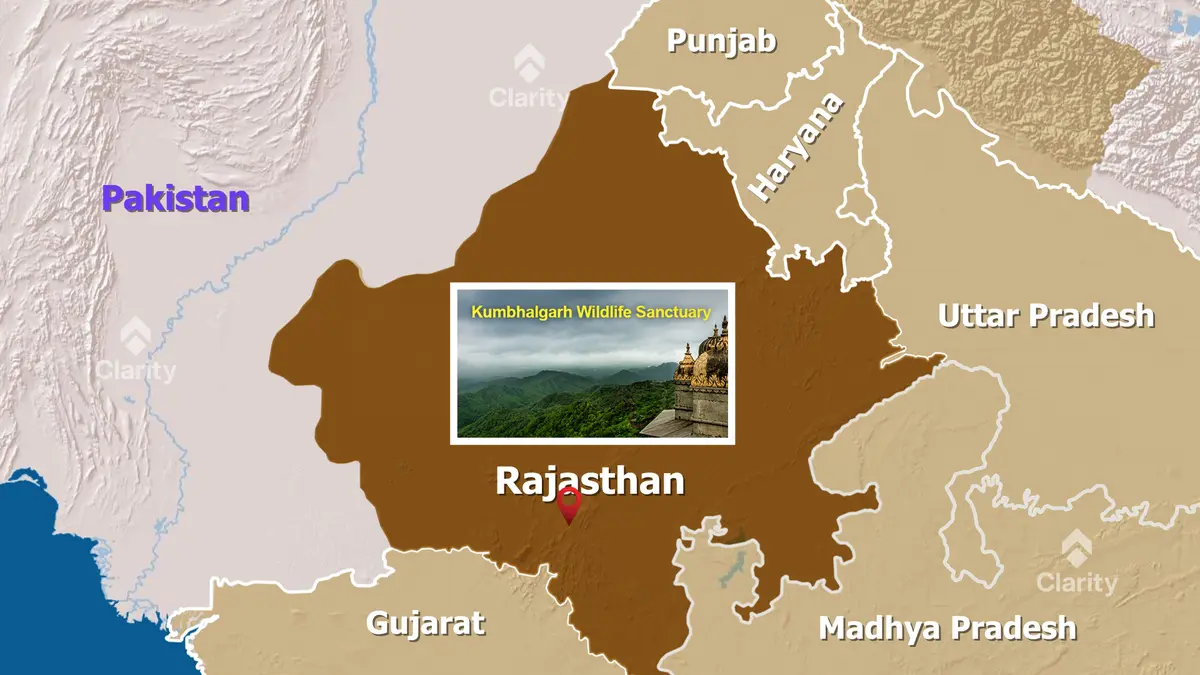
The Ministry of Environment, Forest and Climate Change notified a zero‑to‑one kilometre eco‑sensitive zone (ESZ) around Rajasthan’s Kumbhalgarh Wildlife Sanctuary. The declaration covers about 243 square kilometres and affects 94 villages. It prohibits polluting industries, mining, brick kilns and new hotels within the zone, while allowing eco‑friendly tourism and traditional livelihoods.
Background
Established in 1971, Kumbhalgarh Wildlife Sanctuary covers roughly 610 square kilometres across Rajsamand, Udaipur and Pali districts in the Aravalli Range. It surrounds the historic Kumbhalgarh Fort and spans elevations between 500 and 1,300 metres. The rugged terrain is drained by the Banas and Luni rivers’ tributaries. The sanctuary’s dry deciduous forests contain trees like dhok (Anogeissus pendula), salai (Boswellia serrata) and many medicinal plants. Wildlife includes leopards, sloth bears, sambar, nilgai, chinkara, four‑horned antelope, hyenas, jackals and over 200 species of birds, such as painted francolin and Indian skimmer.
Details of the ESZ notification
- Activity restrictions: Commercial mining, stone quarrying, brick kilns, polluting industries and windmills are banned in the ESZ. New hotels and resorts are not permitted within one kilometre of the sanctuary boundary.
- Buffer and protection: The ESZ acts as a buffer between the core wildlife habitat and human settlements, reducing environmental degradation and minimising human‑wildlife conflict.
- Community impact: The notification may affect local livelihoods such as small mining and construction, but it encourages eco‑tourism, traditional agriculture and handicrafts. Authorities will work with villagers to develop sustainable alternatives.
Why the sanctuary is important
- Biodiversity hotspot: The sanctuary is part of a global “Key Biodiversity Area” and serves as a corridor for wildlife movement in the Aravalli landscape. It provides habitat for endemic and endangered species.
- Cultural heritage: It surrounds the Kumbhalgarh Fort, a UNESCO World Heritage Site known for its massive walls and architecture. The sanctuary thus combines natural and cultural tourism.
- Water catchment: Forests in the sanctuary protect the catchments of the Banas and Luni river systems, which are vital for agriculture and drinking water in downstream districts.
Conclusion
Declaring an eco‑sensitive zone around Kumbhalgarh Wildlife Sanctuary aims to balance conservation with sustainable development. By restricting harmful activities and promoting eco‑friendly practices, the notification seeks to protect wildlife habitats and ensure that the benefits of conservation reach local communities.
Sources: THE PRINT