
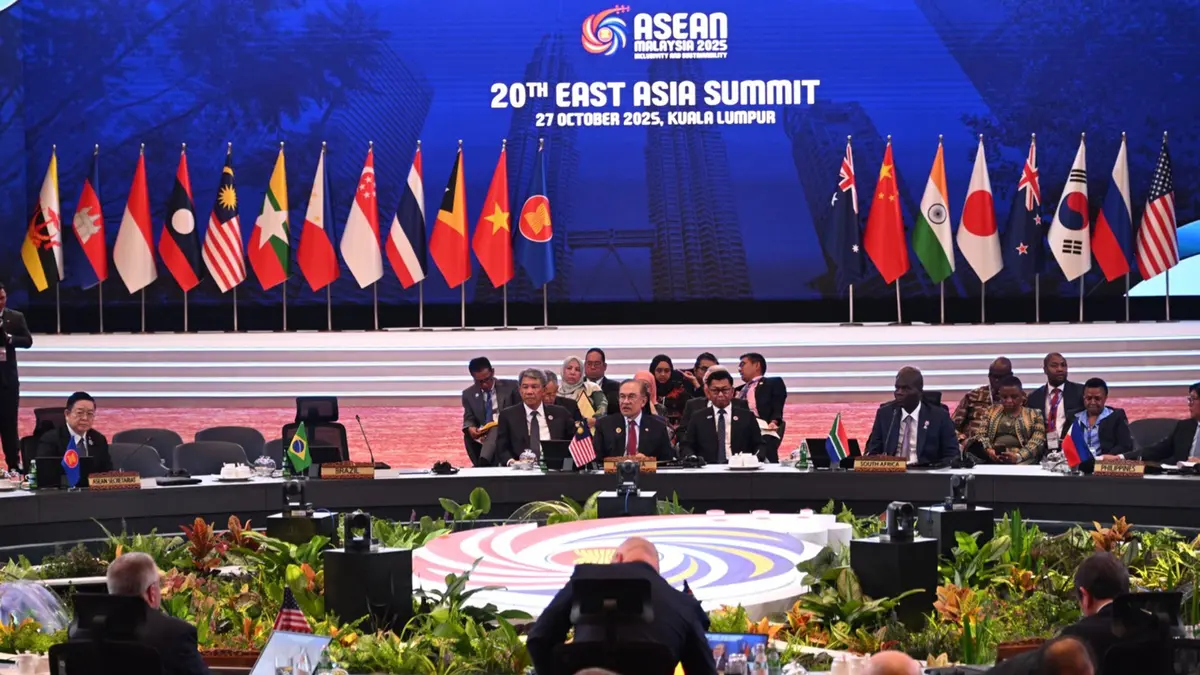
Why in news?
The 20th East Asia Summit (EAS) was held in Kuala Lumpur, Malaysia, on 27 October 2025. Leaders adopted the Kuala Lumpur Declaration on the Twentieth Anniversary of the EAS, reaffirming their commitment to peace, stability and cooperation in the Indo‑Pacific region.
Background
The EAS was inaugurated in 2005 as a leaders‑level forum for strategic dialogue and cooperation. It comprises 18 members: the ten ASEAN countries (Brunei, Cambodia, Indonesia, Laos, Malaysia, Myanmar, the Philippines, Singapore, Thailand and Vietnam) along with Australia, China, India, Japan, New Zealand, the Republic of Korea, Russia and the United States. The summit complements ASEAN‑centric processes by involving major powers in discussions on regional security, economic integration and sustainable development. The chairmanship rotates among ASEAN states; Malaysia chaired the 2025 summit.
Key points of the declaration
- Reaffirmation of past commitments: The declaration recalls earlier EAS statements — such as the 2005 Kuala Lumpur Declaration, the 2010 Hanoi Declaration and the 2015 Kuala Lumpur Declaration — and underscores support for ASEAN’s central role in the regional architecture.
- Peace and stability: Leaders stressed the need to maintain peace, stability and freedom of navigation in accordance with international law, including the UN Convention on the Law of the Sea (UNCLOS). They called for peaceful resolution of disputes and encouraged dialogue to build strategic trust.
- Cooperation in priority areas: The summit emphasised cooperation in maritime security, counter‑terrorism, disaster management, energy security, digital economy, education and health. Members agreed to strengthen the EAS to respond to emerging challenges such as climate change and pandemics.
- Inclusive Indo‑Pacific: The declaration welcomes the ASEAN Outlook on the Indo‑Pacific and supports an open, inclusive and rules‑based regional order. It highlights economic integration through initiatives like the Regional Comprehensive Economic Partnership (RCEP).
Significance
The Kuala Lumpur Declaration marks two decades of the EAS and signals unity amid geopolitical tensions. By reaffirming ASEAN centrality and international law, the summit seeks to prevent escalation of conflicts in the South China Sea and other hotspots. For India, which has been an EAS member since the beginning, the forum provides a platform to promote its Act East policy, enhance maritime cooperation and engage major powers on issues such as connectivity, supply chains and security.
Sources: Australian Department of Foreign Affairs and Trade overview of EAS · Sentinel Assam article on Kuala Lumpur Declaration