
Why in news?
Jordan has appeared frequently in Middle East news due to its role in regional diplomacy, its hosting of large refugee populations and its efforts to modernise the economy. Understanding key facts about the kingdom provides important context for these developments.
Core facts
- Official name: Hashemite Kingdom of Jordan.
- Capital and largest city: Amman. The city grew from an ancient settlement named Rabbath‑Ammon and later became the Roman city of Philadelphia.
- Population: Approximately 11.85 million people in 2025. About 90 percent of Jordanians live in urban areas.
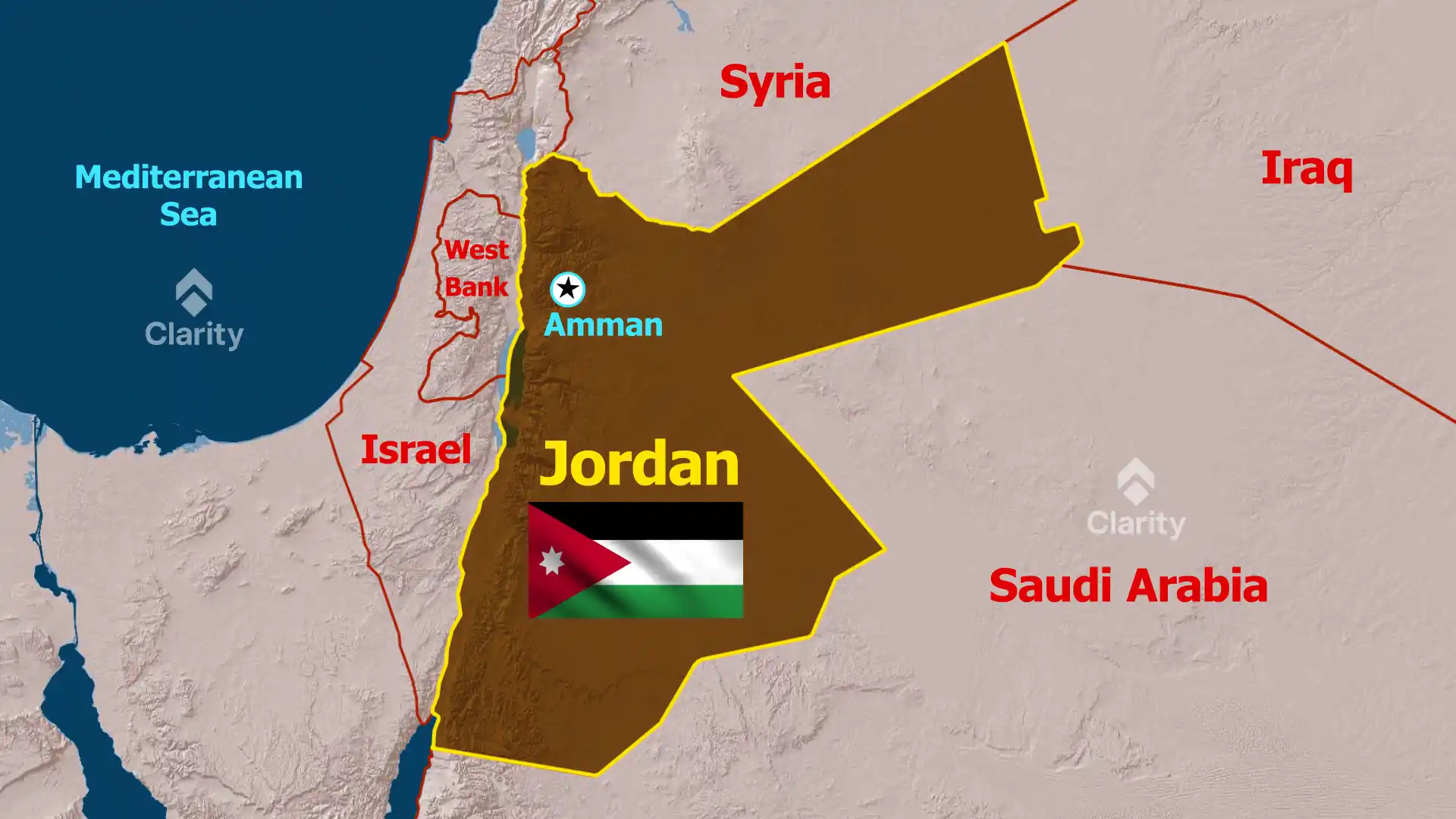
- Area: 88,794 square kilometres—slightly smaller than Portugal. The country is bordered by Syria to the north, Iraq to the east, Saudi Arabia to the south and east and Israel and the West Bank to the west. Jordan has a 26‑km coastline on the Gulf of Aqaba, where the port of Aqaba is located.
- Form of government: Constitutional monarchy headed by King Abdullah II with a prime minister and a bicameral legislature.
- Language and religion: Arabic is the official language; Islam is the state religion.
- Physiography: Jordan’s landscape comprises three regions: the eastern desert (part of the Syrian/Arabian Desert), uplands east of the Jordan River and the Jordan Valley. The Dead Sea on the western border is the lowest point on Earth at about 430 m below sea level.
Socio‑economic context
- Resource constraints: Jordan is one of the world’s most water‑scarce countries and depends heavily on energy imports. Rapid population growth—from under five million in 2000 to over eleven million today—has strained infrastructure and public services.
- Refugees: The kingdom hosts around 475,000 registered refugees, mainly from Syria, which constitutes about 4 percent of its population.
- Economy: The service sector, including tourism and financial services, dominates economic activity. Average economic growth over the past decade has been about 2.5 percent. Unemployment remains high at around 21 percent, and labour force participation, especially among women, is low.
- Reforms: In 2021 the government launched a ten‑year Political, Public Sector and Economic Modernisation Agenda to strengthen democratic participation, improve governance and boost private‑sector investment.
Historical highlights
- Independence: Jordan emerged as the independent Hashemite Kingdom of Transjordan in 1946 after Britain’s mandate ended.
- Monarchy: The country has been ruled by the Hashemite family since independence. King Hussein reigned from 1952 to 1999 and steered Jordan through wars and political turbulence. King Abdullah II ascended the throne in 1999.
- Cultural heritage: Jordan boasts archaeological treasures such as the Nabataean city of Petra, the Roman ruins at Jerash and desert castles like Qasr Amra.
Conclusion
Jordan plays a pivotal role in Middle Eastern politics as a relatively stable country amid regional turmoil. Its limited natural resources and large refugee population present ongoing challenges, but reform programmes aim to modernise the economy and strengthen governance.
Sources: DDNEWS