
Why in news?
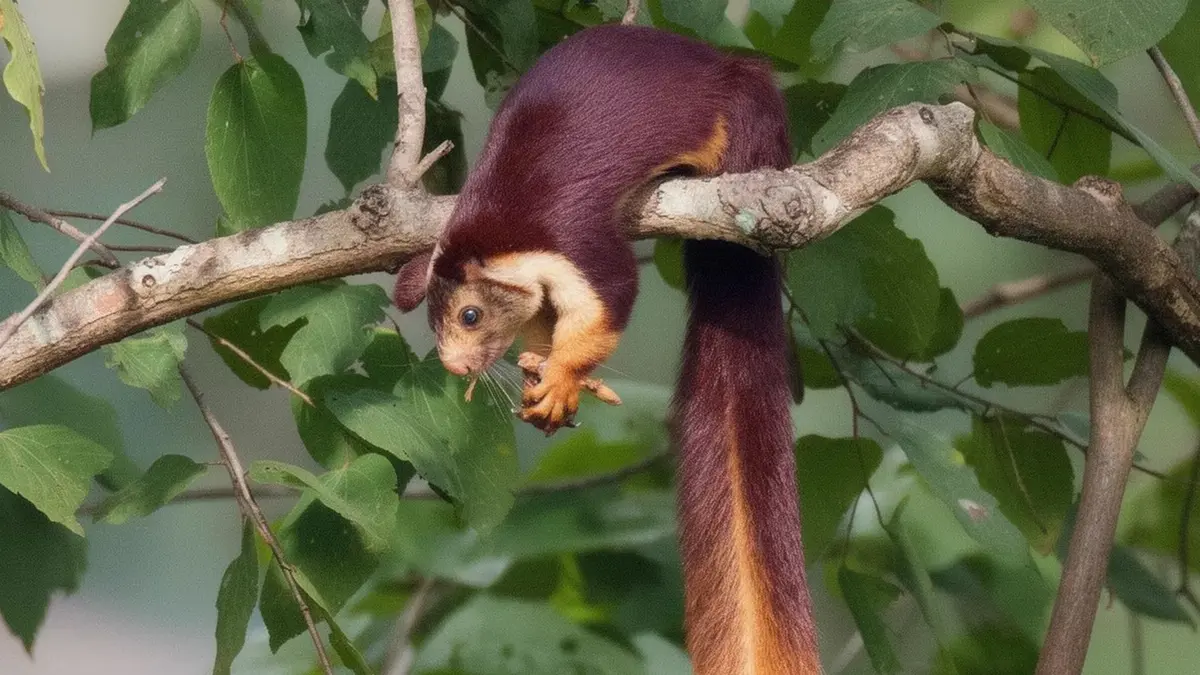
During the All‑India Tiger Estimation survey, forest officials in Pune district spotted the elusive Indian giant squirrel (also called the Malabar giant squirrel). The sighting highlights the species’ presence in fragmented forests outside its usual strongholds and underscores the importance of habitat conservation.
Background
The Indian giant squirrel (Ratufa indica) is a large tree‑dwelling rodent endemic to the moist and deciduous forests of peninsular India. Adults measure about 25–45 cm in body length with a tail of similar length and weigh roughly 1.5–2 kilograms. Their striking fur combines maroon, beige, black and orange patches, giving them a unique tri‑coloured appearance. Long, bushy tails aid balance while leaping between trees.
Habitat and behaviour
- Arboreal acrobatics: Giant squirrels live almost entirely in the tree canopy, rarely coming to ground. They are capable of leaps up to 6 metres between branches. Individuals are typically solitary or found in pairs, communicating through loud calls.
- Diet and nesting: Their diet comprises fruits, nuts, flowers and tree bark. They build large spherical nests, often high in the branches, which they line with leaves and twigs. These nests are reused and maintained throughout the year.
- Distribution: The species inhabits the Western Ghats, Eastern Ghats and central Indian hill ranges. Sightings in Pune’s Atwan region suggest small populations persist in isolated forest patches near the Deccan plateau.
Conservation status and significance
- IUCN status: The Indian giant squirrel is listed as Least Concern but is sensitive to habitat fragmentation. Deforestation and conversion of forests to agriculture reduce canopy continuity, isolating populations.
- Indicator species: The presence of giant squirrels indicates healthy, mature forests with a connected canopy. They play a role in seed dispersal, helping regenerate native trees.
- Conservation efforts: Protecting contiguous forest corridors, controlling logging and involving local communities in tree planting are crucial to sustain the species. Raising public awareness about these charismatic rodents can garner support for forest conservation.
Conclusion
The Indian giant squirrel’s colourful presence and ecological role make it a cherished part of India’s natural heritage. Conservation measures that maintain continuous forest canopy will ensure that these acrobatic creatures continue to thrive.
Source: The Indian Express