
Why in news?
The Indian Space Research Organisation (ISRO) announced that its Dust Experiment instrument recorded an interplanetary dust particle entering Earth’s upper atmosphere roughly every 1,000 seconds—about once every 16 minutes. The finding, made during tests in early 2024, has important implications for India’s human spaceflight plans.
Background
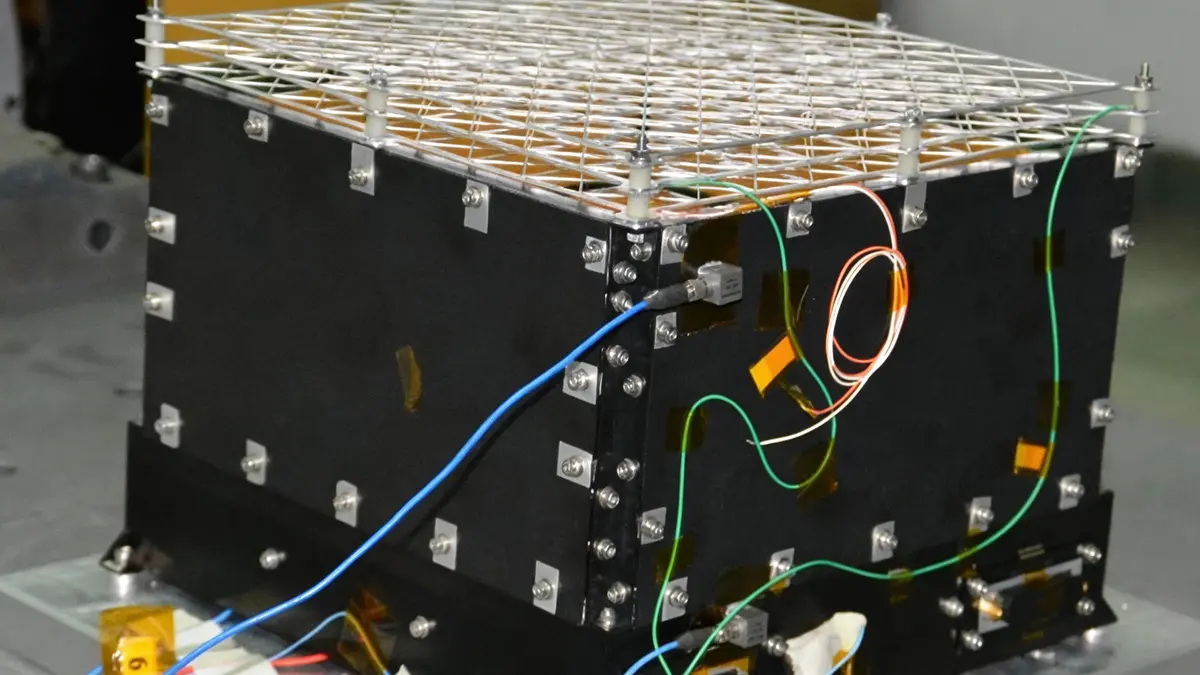
DEX is the first Indian‑built instrument designed to detect tiny, high‑speed interplanetary dust particles (IDPs). Developed by the Physical Research Laboratory in Ahmedabad, the 3‑kilogram device uses the hypervelocity impact principle to capture signals of micrometre‑sized particles as they slam into its detector. It flew aboard the PSLV‑C58/XPoSat mission on 1 January 2024 as part of the PSLV Orbital Experimental Module.
Features of DEX
- Compact design: Weighing only 3 kg and consuming just 4.5 W of power, DEX is small enough to fly on multiple missions.
- Wide field of view: Its 140° detector can record impacts from a broad swath of the sky while orbiting at about 350 km altitude.
- Hypervelocity detection: The instrument measures the minute electrical signals produced when dust particles travelling at kilometres per second collide with its sensor.
- Prototype for future missions: The technology could be adapted to study dust environments around other planets and moons.
What are interplanetary dust particles?
- Origin: IDPs are microscopic fragments shed from comets, asteroids and meteoroids. They form part of our solar system’s “meteor layer” and sometimes appear as shooting stars.
- Why study them? Dust particles influence space weather, affect satellite operations and carry clues about the early solar system. Understanding their flux helps design shielding for spacecraft and crewed missions.
Significance of the findings
- Safety for human missions: By quantifying dust flux in Earth’s atmosphere, ISRO can better protect astronauts in future Gaganyaan missions and design shields for lunar and planetary exploration.
- Space environment monitoring: Continuous measurement of cosmic dust contributes to tracking space weather and protecting satellites from hypervelocity impacts.
- Scientific insight: The data improves our understanding of interplanetary dust dynamics and paves the way for similar instruments on missions to Mars and Venus.
Source: The Indian Express