
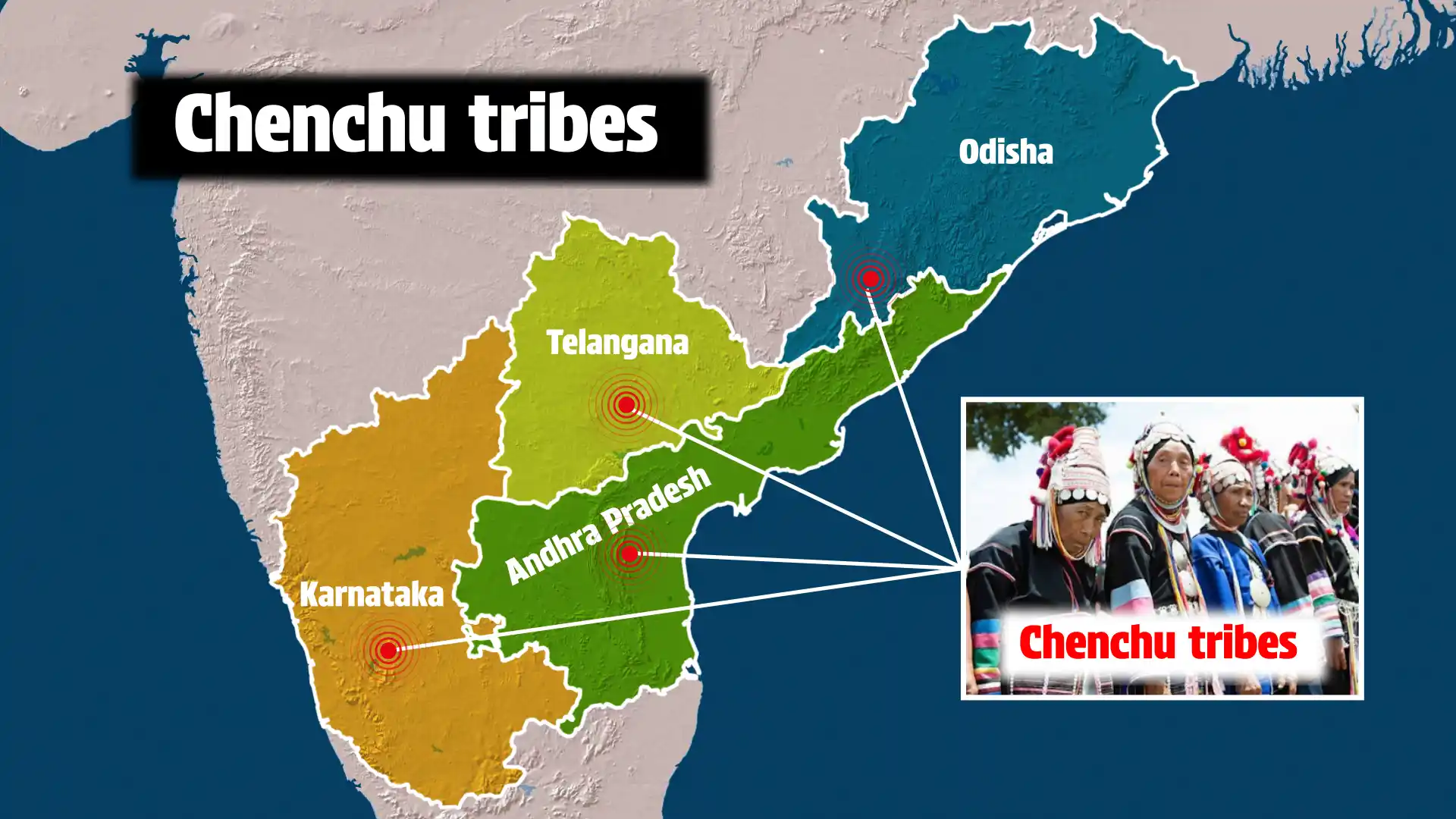
Why in news?
The National Sanskrit University recently hosted a symposium and exhibition celebrating the Chenchu tribe’s special privileges at the Ahobilam shrine dedicated to Lord Narasimha. The event explored how tribal legends, particularly the story of Narasimha’s marriage to a Chenchu woman, continue to shape religious traditions in Andhra Pradesh.
Background
The Chenchus are a tribal people who live mainly in the Nallamala forests of Andhra Pradesh. Recognised as a Particularly Vulnerable Tribal Group (PVTG), they traditionally survive by hunting and gathering, though many now work as forest labourers or small farmers. Their villages, called pentas, consist of scattered thatched huts. Chenchu society is based on small family groups with elders acting as community leaders.
Culture and livelihood
- Hunter–gatherer roots: The Chenchus collect wild honey, tubers, roots, fruits, flowers and leaves. Simple tools like bows, arrows and knives aid them in hunting and gathering.
- Language and identity: They speak variants of Telugu and maintain distinct cultural practices. A Chenchu settlement is loosely structured, with families spaced apart but united by kinship.
- Religious beliefs: Chenchus worship forest spirits and local deities. Over time they have adopted Hindu customs and participate in rituals at temples like Srisailam and Ahobilam. According to legend, Lord Narasimha married a Chenchu girl named Chenchu Lakshmi to calm his anger after slaying the demon Hiranyakashipu; this story is retold during festivals at Ahobilam.
- Special privileges: At the Srisailam temple, Chenchus enjoy hereditary rights to collect forest produce and perform certain rituals. This relationship underscores their long association with the region’s sacred geography.
Challenges and progress
- Marginalisation: Many Chenchu hamlets are remote, lacking basic services like roads, schools and healthcare. Their semi‑nomadic lifestyle often excludes them from formal development schemes.
- Development initiatives: Government programmes, such as special projects under the Mahatma Gandhi National Rural Employment Guarantee Scheme (MGNREGS), have introduced village organisations and computer centres to deliver guaranteed employment and direct payments. These initiatives have improved food security, reduced malnutrition and encouraged school enrolment among Chenchu children.
- Balancing tradition and change: Efforts to modernise livelihoods must respect Chenchu culture. Empowering tribal leaders and ensuring community participation are vital for sustainable development.
Conclusion
The Chenchu tribe’s deep connection to their forest homeland and their unique role in Hindu mythology make them an integral part of India’s cultural mosaic. Preserving their traditions while enhancing their quality of life requires sensitive, participatory development approaches.
Source: TH