
Why in news?
Wildlife biologists have been highlighting the behaviour and conservation challenges of the black‑capped capuchin monkey, drawing attention to this charismatic species found in South America. Recent observations of tool use and complex social interactions have renewed interest in these intelligent primates and the threats they face from habitat loss and hunting.
Background
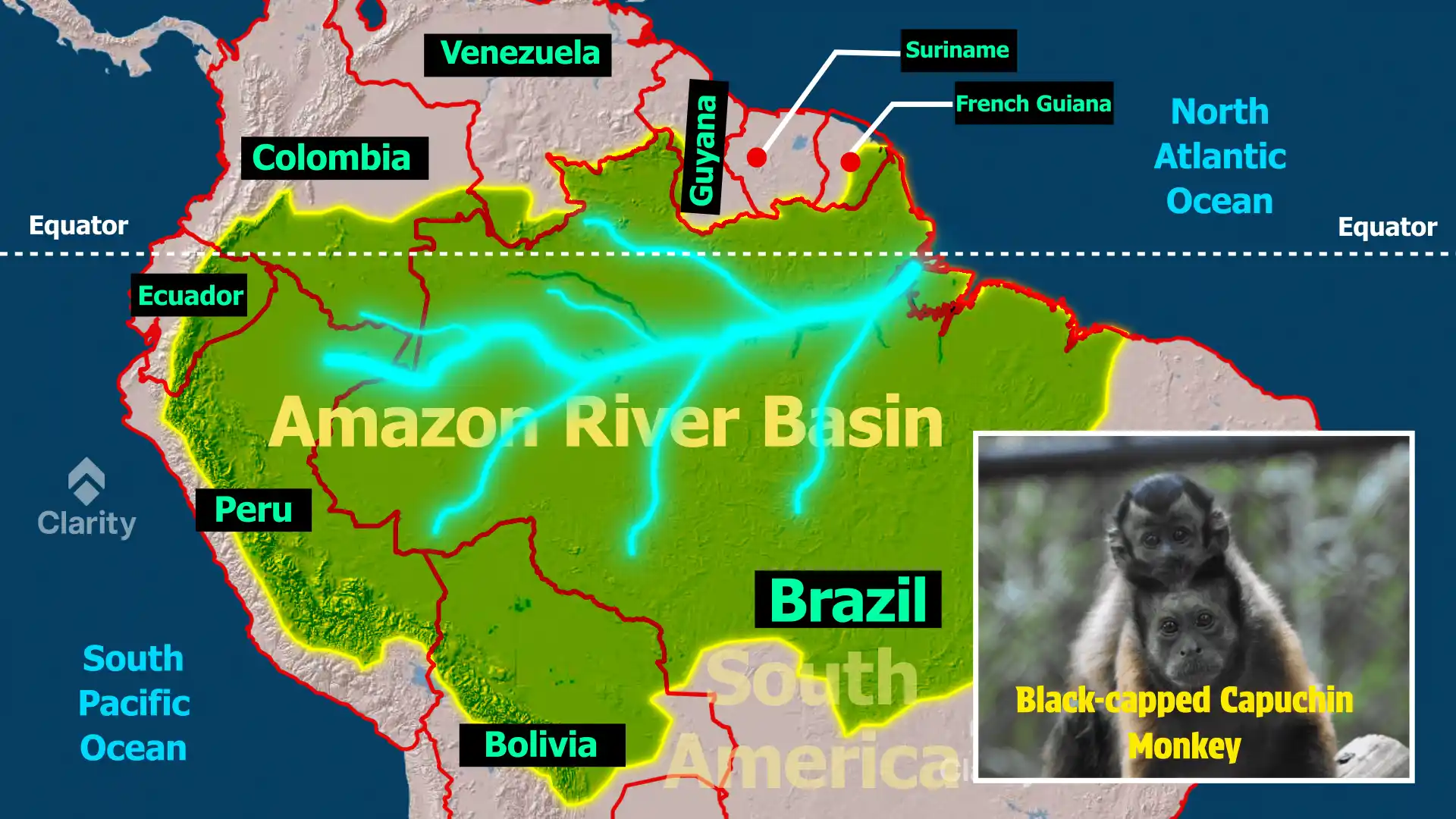
Also known as the tufted or black‑capped capuchin (Sapajus apella), this medium‑sized monkey is native to a wide swathe of South America, including Bolivia, Brazil, Colombia, Ecuador, French Guiana, Guyana, Peru, Suriname and Venezuela. There is also an introduced population on Trinidad and Tobago. Capuchins inhabit a variety of forest types – tropical rainforests, dry deciduous forests, mangroves and savannahs – and are most often found in the middle and lower canopy, where they forage for food and avoid predators.
Characteristics
- Appearance: Adult males weigh around 3 kilograms and females about 2.4 kilograms. Their bodies measure roughly 40 centimetres in length, with tails nearly as long. The fur is light brown on the torso, while the limbs and tail are darker. A distinctive black “cap” of coarse hair above the forehead gives the species its common name.
- Diet: Black‑capped capuchins are omnivorous. They eat fruit, nuts, seeds, leaves, flowers and pith, along with insects, frogs, lizards, birds and small mammals. Their strong jaws enable them to crack hard nuts and tough palm pith during dry seasons.
- Social structure: Groups of 10–20 individuals live together, usually comprising a few adult males and several females with their offspring. Capuchins are highly intelligent and have been observed using stones to crack open nuts, leaves as sponges and sticks to probe for insects. Social bonds are reinforced through grooming and play.
- Reproduction: Females give birth to a single infant after a gestation of about six months. The young are carried by the mother and other females and are weaned at around nine months. Capuchins reach maturity between four and seven years of age.
Conservation status
- IUCN listing: The species is classified as Least Concern because of its wide distribution and adaptability. However, local populations are declining in areas where forests are cleared for agriculture or where hunting pressure is high.
- Threats: Habitat loss from logging, ranching and mining is a major threat. Capuchins are also hunted for bushmeat and trapped for the pet trade. Their curiosity makes them easy targets for capture.
- Protection measures: Many capuchin populations live in protected areas and national parks. Internationally they are listed under CITES Appendix II, which restricts trade. Conservationists advocate habitat preservation, anti‑poaching patrols and public awareness campaigns to reduce demand for pet primates.
Conclusion
The black‑capped capuchin is a remarkable primate with sophisticated behaviours and important ecological roles such as seed dispersal. Ensuring that this adaptable monkey continues to thrive will require protecting its forest homes and curbing unsustainable hunting and trade. Greater appreciation of its intelligence and social life may help generate support for conservation initiatives across its range.
Source: TH